Indoor air quality is a growing health concern in India’s cities — where rising pollution levels, sealed modern buildings, synthetic furnishings, and chemical off-gassing from paints and cleaning products create indoor environments that can contain pollutant concentrations 2–5 times higher than outdoor air. NASA’s landmark Clean Air Study demonstrated that certain houseplants actively remove volatile organic compounds (VOCs) including benzene, formaldehyde, trichloroethylene, xylene, and ammonia from indoor air through phytoremediation — making carefully selected indoor plants a beautiful, affordable, and scientifically supported tool for improving the air quality in your home.
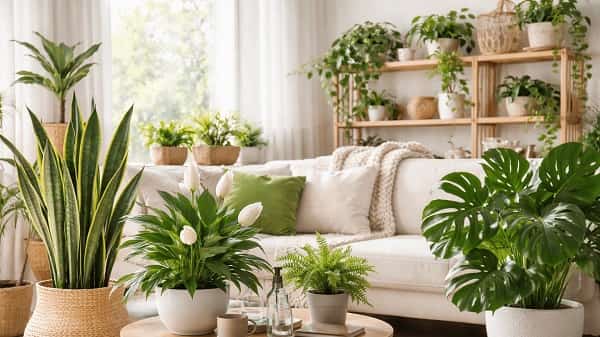
The following five plants represent the best combination of proven air purification effectiveness, ease of care in Indian home conditions, and aesthetic appeal for everyday households.
| Plant Name | Best For | Light Needs | Care Level | Toxicity |
| Snake Plant (Sansevieria) | Benzene, formaldehyde removal + night oxygen | Low — tolerates shade | Very Easy | Mildly toxic to pets |
| Peace Lily (Spathiphyllum) | Ammonia, benzene, formaldehyde | Low to Medium | Easy | Toxic to pets and children |
| Money Plant (Pothos) | Formaldehyde, xylene, benzene | Low to Medium | Very Easy | Mildly toxic to pets |
| Spider Plant (Chlorophytum) | Carbon monoxide, formaldehyde | Medium | Very Easy | Non-toxic — pet safe |
| Areca Palm (Dypsis lutescens) | Humidity addition, xylene, toluene | Bright indirect | Moderate | Non-toxic — pet safe |
1. Snake Plant (Sansevieria / Mother-in-Law’s Tongue)
The snake plant is arguably India’s single most recommended indoor air purification plant — combining exceptional air cleaning capability with near-indestructible hardiness that makes it the ideal choice for beginners and busy households. Its stiff, upright sword-shaped leaves in deep green with light green or yellow banding create a bold, architectural aesthetic that suits both modern and traditional Indian home interiors.
The snake plant’s unique distinction among air purifying plants is its ability to perform Crassulacean Acid Metabolism (CAM) photosynthesis — absorbing carbon dioxide and releasing oxygen at night rather than during the day like most plants. This makes it one of the best plants specifically for bedrooms, where nighttime oxygen production genuinely improves sleep environment air quality. It effectively removes formaldehyde, benzene, trichloroethylene, and xylene from indoor air — all compounds commonly emitted by furniture, paints, and cleaning products.
Care requirements are minimal — water once every 2–3 weeks, tolerates low light and neglect better than almost any other houseplant, and thrives in the warm temperatures of Indian homes year-round. A single medium-sized pot costs ₹150–₹400 at most Indian nurseries.
2. Peace Lily (Spathiphyllum)
The peace lily is one of the most effective air purifying plants ever tested by NASA — demonstrating exceptional ability to remove ammonia, benzene, formaldehyde, trichloroethylene, and acetone from indoor environments. Its lush, deep green glossy leaves and elegant white spatha flowers make it one of the most aesthetically refined indoor plants available — equally appropriate in a corporate office or a home living room.
The peace lily is particularly effective in Indian kitchens and bathrooms — spaces where ammonia-based cleaners, chemical products, and moisture create specific air quality challenges. It also acts as a natural humidifier, transpiring moisture that improves indoor humidity in air-conditioned rooms that become excessively dry during summer. Care involves watering once a week, keeping away from direct sunlight, and occasional misting — overall a low-maintenance plant that communicates clearly when it needs water by gently drooping its leaves. Important note: peace lily is toxic to cats, dogs, and small children if ingested — placement out of reach is essential for households with pets or toddlers.
3. Money Plant (Pothos / Epipremnum aureum)
The money plant is India’s most beloved and most widely grown indoor plant — found in homes, offices, and public spaces across the country, often trailing from high shelves or growing in water vessels on windowsills. Beyond its cultural association with prosperity and good fortune, money plant is scientifically validated as an effective air purifier — removing formaldehyde, xylene, benzene, and carbon monoxide from indoor environments, making it particularly valuable in homes near busy roads where vehicular pollution infiltrates indoor spaces.
Its exceptional vigour — thriving in both soil and water, in low light and bright indirect light, with minimal watering and minimal fertilisation — makes it India’s most accessible entry point into indoor gardening and air purification simultaneously. Propagation is effortless — a single stem cutting placed in water roots within days — making it easy to create multiple plants from one original purchase. Heart-shaped leaves in bright green or variegated yellow-green bring natural freshness to any indoor space. At ₹50–₹150 per plant, it is among India’s most affordable houseplants.
4. Spider Plant (Chlorophytum comosum)
The spider plant is one of the safest and most effective air purifying plants for Indian homes — completely non-toxic to pets and children, making it uniquely appropriate for households with cats, dogs, or young children who might handle or ingest plant material. It is highly effective at removing formaldehyde and carbon monoxide — pollutants produced by gas cooking, cigarette smoke, and outdoor traffic that enter Indian homes readily.
The spider plant’s rapidly growing arching green and white striped leaves and the characteristic baby plantlets — miniature spider plants that dangle from long runners — create a lush, cascading effect that is particularly beautiful in hanging baskets or on elevated shelves where the babies can trail freely. It is extremely easy to care for — tolerates irregular watering, adapts to varied light conditions, and grows vigorously without fertiliser in Indian home temperatures. Baby plantlets can be separated and repotted to multiply your collection effortlessly.
5. Areca Palm (Dypsis lutescens / Butterfly Palm)
The areca palm is India’s premier large indoor air purifying plant — offering not just VOC removal but also significant moisture transpiration that raises indoor humidity to comfortable levels in the excessively air-conditioned environments that many Indian urban homes maintain during summer. Its elegant, feathery fronds in bright green create a tropical aesthetic that transforms living rooms, entryways, and large spaces with a sense of lush natural abundance.
NASA research found the areca palm among the most effective houseplants for removing toluene and xylene from indoor air — chemicals commonly associated with paints, varnishes, and furniture off-gassing in newly furnished or recently renovated Indian homes. It is completely non-toxic to pets and humans — a meaningful safety advantage for family homes. Care requires bright indirect light, regular watering without waterlogging, and occasional fertilising during growing season. A healthy 3–4 foot areca palm creates a genuinely impressive indoor focal point at ₹400–₹1,500 from Indian nurseries.
Frequently Asked Questions (FAQs)
Q: How many indoor plants are needed to purify air in a room?
A: NASA’s research suggests approximately one medium-to-large plant per 9–10 square metres of floor space provides meaningful air quality improvement. A 200 sq ft room benefits from 2–3 medium plants placed strategically.
Q: Which indoor air purifying plant is safest for homes with pets?
A: Spider plant and areca palm are both completely non-toxic to cats and dogs. Money plant is mildly toxic if ingested. Peace lily is significantly toxic and should be kept completely out of reach of pets.
Q: Do indoor plants really improve air quality?
A: Yes — NASA’s Clean Air Study and subsequent research confirm that houseplants absorb VOCs through leaf surfaces and root systems. Effectiveness depends on plant size, leaf surface area, and ventilation conditions.
Q: Which air purifying plant needs the least care?
A: Snake plant and money plant are both extremely low-maintenance — tolerating neglect, irregular watering, and low light conditions while continuing to effectively purify air.
Q: Can I keep air purifying plants in the bedroom?
A: Yes — snake plant is specifically recommended for bedrooms as it releases oxygen at night. Money plant and spider plant are also safe bedroom choices.