Clear vision plays a quiet but important role in everyday independence, from reading and driving to recognising faces and moving around comfortably. When a cataract begins to cloud the natural lens of the eye, these familiar activities may gradually become difficult.
Surgery can replace the cloudy lens with an artificial intraocular lens, but the procedure can be performed using different techniques. Understanding how laser-assisted and conventional approaches differ can make discussions with an ophthalmologist clearer and more meaningful.
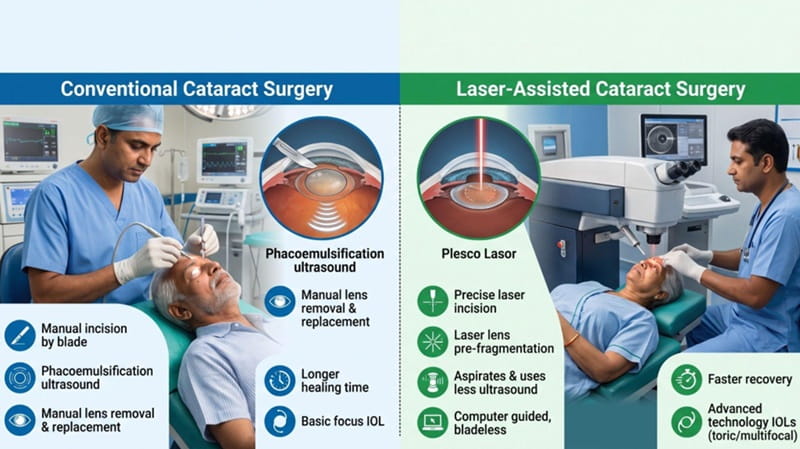
What Is Laser Cataract Surgery?
Laser cataract surgery uses a specialised laser to assist with certain steps of removing a cloudy lens. The laser can help create precise incisions and break the cataract into smaller pieces for easier removal. During cataract surgery, the cloudy natural lens is replaced with a clear artificial lens. The procedure is planned according to the patient’s eye condition, and the laser supports selected stages rather than performing the entire surgery.
What Is Conventional Cataract Surgery?
Conventional cataract surgery generally relies on the surgeon to perform key steps manually using specialised microsurgical instruments. In modern Phaco surgery, an ultrasound probe breaks the cloudy natural lens into smaller pieces so that they can be removed through a small incision. The surgeon then places an artificial intraocular lens inside the eye to restore the focusing function previously performed by the natural lens.
Key Differences between Laser Cataract Surgery and Conventional Cataract Surgery
Both methods aim to remove the cloudy lens and replace it with an artificial lens. The main difference lies in how certain surgical steps are performed. Research suggests that both approaches can provide similar safety and visual outcomes for many patients.
| Aspect | Laser-Assisted Approach | Conventional Approach |
| Incisions | A femtosecond laser may create selected incisions. | The surgeon creates incisions manually. |
| Lens Capsule | Laser may assist with creating the opening. | The opening is created using microsurgical instruments. |
| Lens Fragmentation | Laser can soften or divide the cataract before removal. | Ultrasound energy is commonly used to break up the cloudy lens. |
| Precision | Technology assists with repeatability during selected steps. | Precision depends largely on surgical technique and instruments. |
| Cost Consideration | Additional technology may influence the overall cataract surgery cost. | May involve fewer technology-related charges. |
Which Cataract Surgery Option May Be Suitable for Different Patients?
There is no single technique that automatically suits every eye. An ophthalmologist considers the health of the eye, type of cataract, corneal condition, planned intraocular lens and other clinical factors before recommending a procedure.
Generally:
- Conventional surgery may be appropriate for many routine cataract cases.
- Laser-assisted surgery may be considered when greater automation of selected surgical steps is useful.
- Existing eye conditions can influence whether either approach is appropriate.
- Personal expectations and the planned lens implant may also form part of the discussion.
The final recommendation should follow a complete eye examination rather than technology preference alone.
Technology Used in Each Procedure
The technology involved is one of the clearest distinctions between the procedures. Femtosecond laser systems can assist with corneal incisions, capsulotomy and lens fragmentation. At the same time, conventional phacoemulsification relies more heavily on the surgeon performing these stages manually and using ultrasound for lens removal.
The main technologies include:
- Laser-assisted procedure: Femtosecond laser technology, imaging guidance, phacoemulsification equipment where required, and an intraocular lens.
- Conventional procedure: Microsurgical instruments, a phacoemulsification machine using ultrasound energy, and an intraocular lens.
Factors to Consider When Choosing between the Two
Here you will explore the factors to consider when choosing between laser cataract surgery and conventional cataract surgery.
Eye Health and Cataract Characteristics
Eye health, cataract type and corneal condition can influence which procedure is suitable.
Precision and Lens Planning
Laser assistance may offer added precision for selected steps, while conventional surgery remains effective for many patients.
Surgeon Experience
The ophthalmologist’s experience and clinical judgement are important when deciding the safest and most appropriate approach.
Treatment Cost and Availability
Laser-assisted surgery may cost more because it uses specialised technology and may not be available everywhere.
Individual Expectations
Comfort, visual needs and personal preferences should be discussed before choosing a procedure.
Conclusion
Laser-assisted and conventional techniques follow the same fundamental goal: removing the cloudy natural lens and replacing it with a clear artificial lens. Their key difference is how certain stages of the procedure are completed, with laser technology assisting selected steps in one approach and the surgeon performing them manually in the other. Neither option should be considered universally superior. A detailed eye assessment and discussion with a qualified ophthalmologist can help determine the more suitable approach for an individual patient.