Paytm and Google Pay represent two fundamentally different philosophies in India’s digital payment ecosystem — Paytm is the homegrown fintech pioneer that built India’s first major digital wallet and now operates a comprehensive financial services platform, while Google Pay is the globally backed technology giant that entered India in 2017 and rapidly captured 35% of UPI market share through unmatched simplicity and Google’s trusted brand. In 2026, comparing these two platforms requires looking beyond market share numbers to understand which genuinely serves different users better across real-world payment scenarios.
Both platforms are technically safe, NPCI-compliant, and capable of handling everyday Indian digital payments. The meaningful differences lie in ecosystem depth, user experience philosophy, regulatory history, and which specific features matter most to your usage patterns.
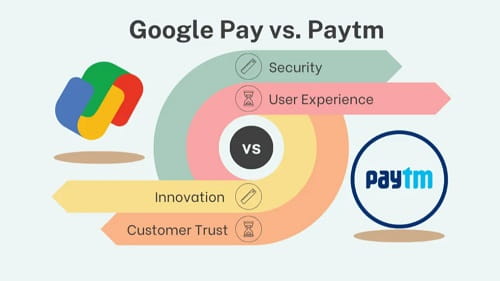
Quick Comparison Table — Paytm vs Google Pay
| Category | Paytm | Google Pay (GPay) |
| Parent Company | One97 Communications Ltd. | Google LLC |
| Founded | 2010 | 2017 (India launch as Tez) |
| Headquarters | Noida, India | Mountain View, USA |
| UPI Market Share | ~7.4% | ~35% |
| Monthly Transactions | 1,523 million | 7,166 million |
| Transaction Value | ₹1.67 lakh crore | ₹9.5 lakh crore |
| Wallet Available | No new top-ups (post-PPBL) | No independent wallet |
| Payment Type | UPI + Wallet (limited) | Pure UPI (bank-linked) |
| Financial Services | Very comprehensive | Limited |
| Merchant Soundbox | Industry-leading (30M+ devices) | Not available |
| Security Framework | Multi-layer + real-time monitoring | NPCI Mobile App Security 2025 |
| Fraud Protection | Real-time monitoring | Google-grade security |
| International UPI | UAE, Singapore, France, others | Expanding cross-border |
| Regulatory History | PPBL crisis 2024 | Clean |
| Best For | Comprehensive finance, merchants | Simple daily UPI payments |
User Base and Market Position
Google Pay’s 35% UPI market share processing 7,166 million monthly transactions is nearly five times Paytm’s 1,523 million monthly transactions at 7.4% share. In pure consumer digital payment volume, GPay’s advantage reflects the trust and simplicity that have made it the default choice for India’s urban tech-savvy population, particularly those deeply embedded in the Android and Google ecosystem.
Paytm’s story in 2026 is one of focused recovery — monthly transacting users have stabilised around 7 crore and merchant transaction volumes are growing, with the company operating near breakeven profitability in FY25. After the PPBL crisis significantly disrupted consumer confidence, Paytm has demonstrably rebuilt through stronger compliance, institutional banking partnerships with SBI and HDFC, and an aggressive pivot toward merchant services where it genuinely leads the market.
Interface and User Experience
Google Pay wins this category decisively for everyday payment simplicity. Its clean, minimal interface — designed for fast QR scanning, quick money transfers, and effortless bill payments — reduces cognitive load to almost nothing. First-time digital payment users and senior citizens consistently find GPay the easiest platform to navigate with the fewest confusing menu options or feature overlays.
Paytm’s interface is considerably more complex — a consequence of integrating payments, investments, insurance, gold, travel bookings, and merchant services into a single application. For users who need all those features, the comprehensiveness is a strength. For users who simply want to scan and pay, it can feel unnecessarily overwhelming. Paytm has improved interface clarity in recent versions but the feature density gap with GPay’s intentionally minimal design remains meaningful.
Financial Services Ecosystem
Paytm wins comprehensively on financial services breadth. Beyond payments, Paytm offers Paytm Money for equity trading and mutual fund investment, digital gold purchasing and storage, BNPL through PostPaid, insurance products, FASTag recharges, and the most extensive merchant financial services through Paytm for Business. Bernstein analysis found that Paytm’s merchant revenues are 2x PhonePe’s — and the gap versus Google Pay is even larger, as Google Pay has made minimal investment in merchant financial services.
Google Pay’s financial services offering is intentionally limited — staying close to its core UPI payment identity rather than expanding into investment or lending products. Google Pay Offers provides cashback and merchant deals, but the platform lacks the stock trading, insurance, or lending features that Paytm has built comprehensively. For users who want their primary payment app to also serve as their financial services hub, Paytm is the clear choice.
Merchant Services
Paytm’s merchant services infrastructure is among India’s most impressive payment technology achievements. With 30+ million Soundbox devices deployed nationwide, the largest POS terminal network, and the October 2025 launch of India’s first AI-powered Soundbox offering business insights in 11 languages, Paytm’s merchant toolset has no close equivalent from Google Pay. Google Pay does not offer physical payment devices, audio confirmation technology, or dedicated merchant management tools — its merchant acceptance is entirely QR-code-based within the standard UPI framework.
For individual consumers making payments, this difference is invisible. For business owners and merchants evaluating which platform to support as their primary payment acceptance infrastructure, Paytm’s merchant ecosystem is in an entirely different category from Google Pay.
Security Comparison
Both platforms are technically secure with multi-layer authentication, encryption, and real-time fraud monitoring. Google Pay’s advantage lies in the depth of Google’s global security infrastructure and its NPCI Mobile Application Security Framework 2025 compliance — one of the most rigorous mobile security frameworks applied to Indian payment apps. Google Account recovery also provides superior account restoration speed compared to Paytm’s KYC-dependent recovery process.
Paytm’s regulatory history — the PPBL governance failures — remains a legitimate trust concern for users evaluating platform-level governance quality, even though transaction-level technical security was not compromised. Since the crisis, Paytm has restructured its compliance approach fundamentally, but rebuilding institutional trust takes years rather than months.
Which is Better for You?
Choose Google Pay if you want the simplest, cleanest UPI payment experience backed by world-class security, prefer a pure payment app without financial services complexity, use Android devices and value Google ecosystem integration, and prioritise transaction reliability from a platform with a clean regulatory record.
Choose Paytm if you are a merchant needing comprehensive payment acceptance infrastructure, want an all-in-one financial platform covering investments, insurance, and lending alongside payments, make frequent bill payments and travel bookings within a single app, or are in a Tier-2 or Tier-3 city where Paytm’s physical merchant infrastructure remains particularly strong.
The practical recommendation: For most consumers, GPay is the better primary daily payment app in 2026. Paytm serves as an excellent secondary platform for financial services, merchant interactions, and specific cashback scenarios where its comprehensive ecosystem creates genuine value.
Frequently Asked Questions (FAQs)
Q: Which is faster — Paytm or Google Pay for UPI transactions?
A: Both process UPI transactions through NPCI infrastructure at comparable speeds. GPay is generally rated marginally faster for consumer transactions, while Paytm performs strongly for merchant transaction confirmation through its Soundbox network.
Q: Does Google Pay have a wallet like Paytm?
A: No — Google Pay does not offer an independent prepaid wallet. All transactions draw directly from linked bank accounts. Paytm previously had a wallet through PPBL but new deposits are discontinued.
Q: Which app has better cashback offers?
A: Both offer cashback, but rewards structures differ. Paytm typically offers stronger cashback on utility payments and merchant transactions. GPay’s Offers programme provides merchant-specific deals and scratch card rewards.
Q: Is Google Pay safer than Paytm?
A: Both are technically secure. Google Pay has a cleaner regulatory record. Paytm has stronger financial services and merchant features. For pure payment safety, both are comparably secure.
Q: Which should small business owners prefer?
A: Paytm — its Soundbox devices, POS terminals, merchant management tools, and business lending capabilities create a far more comprehensive merchant services platform than Google Pay offers.