The battle between Paytm and PhonePe represents one of India’s most consequential fintech competitions — two platforms that have collectively shaped how hundreds of millions of Indians make digital payments, experience financial services, and interact with India’s extraordinary UPI ecosystem. In 2026, this comparison is more interesting and more nuanced than ever — PhonePe dominates in transaction volume with approximately 46% UPI market share, while Paytm — significantly recovered from its 2024 regulatory crisis — has repositioned itself as a comprehensive merchant services and financial technology platform operating at approximately 7% market share.
These are not simply two versions of the same product. PhonePe and Paytm have evolved into genuinely different fintech propositions serving overlapping but meaningfully distinct user needs — understanding which is better for you requires clarity about what you actually need from a digital payment platform.
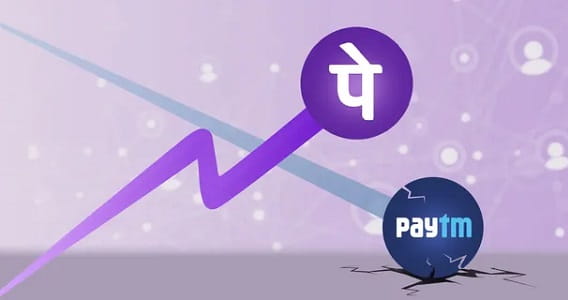
Quick Comparison — Paytm vs PhonePe 2026
| Category | Paytm | PhonePe |
| Parent Company | One97 Communications Ltd. | PhonePe Limited (Walmart-backed) |
| Founded | 2010 | 2016 |
| Listed | Yes — BSE & NSE | IPO expected ~$15 billion |
| UPI Market Share | ~7.4% | ~46.29% |
| Registered Users | 30 Crore+ | 61 Crore+ |
| Monthly Active Users | ~7 Crore | ~25 Crore+ |
| Merchant Network | 4.3 Crore+ | 4.4 Crore+ |
| Wallet Availability | Discontinued for top-up | Fully active Small & Full KYC PPI |
| UPI Model | Multi-bank (post-PPBL) | Independent PPI + UPI |
| Financial Services | Very comprehensive | Comprehensive |
| Paytm Soundbox/QR | Industry-leading | Strong |
| Fraud Protection | Real-time monitoring | PhonePe Protect + DoT FRI |
| Regulatory History | PPBL crisis 2024 | Clean record |
| Profitability | Near breakeven (FY25) | Loss-making (ESOP-adjusted) |
| Best For | Merchants, comprehensive financial services | Daily payments, wide acceptance |
| International UPI | UAE, Singapore, France, others | Expanding |
User Base and Market Position
The numbers tell a clear story about where each platform stands in 2026. PhonePe processes approximately 8.55 billion UPI transactions monthly with a commanding 46% market share — nearly six times Paytm’s 1.27 billion monthly transactions at 7.4% share. PhonePe has 61 crore registered users compared to Paytm’s 30 crore, and roughly 3.5 times more monthly active users. For pure scale of digital payment activity, PhonePe’s dominance is unambiguous.
Paytm’s market position, however, tells a story of recovery and repositioning rather than irrelevance. After the PPBL regulatory crisis decimated its market share from 13% to under 7%, Paytm has stabilised and is growing — merchant transaction volumes actually increased from 1 billion in Q3 FY24 to 1.1 billion in Q3 FY25, and merchant revenue remains 2x PhonePe’s despite the consumer transaction gap. The Bernstein analysis found that after adjusting for non-recurring revenue categories, Paytm’s revenue is actually 20% higher than PhonePe’s on an underlying basis — a striking finding that underlines how the two platforms monetise differently.
Financial Services Ecosystem
Both platforms offer comprehensive financial services, but their strengths differ meaningfully. Paytm leads decisively in lending — disbursals estimated at 2.5–3 times PhonePe’s across both consumer and merchant lending — reflecting Paytm’s deeper experience with its PostPaid BNPL product and merchant credit infrastructure. Paytm also leads in stock trading and investment through Paytm Money, insurance products, digital gold, and the most comprehensive bill payment coverage.
PhonePe has been rapidly building its financial services — offering insurance, mutual fund investments, and digital gold — but the depth of Paytm’s financial services ecosystem remains more comprehensive for users seeking investment and lending products alongside payments. The analyst verdict: Paytm for widest financial services breadth.
Merchant Services
This is where Paytm’s competitive advantage is most clearly visible in 2026. Paytm has deployed 30+ million Soundbox devices — India’s most recognised payment confirmation audio device — and maintains the largest installed base of payment acceptance terminals among all Indian UPI platforms. The Soundbox innovation remains a Paytm-pioneered advantage that competitors have struggled to match in penetration despite offering similar products.
For merchants especially, Paytm’s combination of QR codes, Soundbox audio confirmations, POS card machines, and the AI-powered Soundbox launched in October 2025 offering business insights in 11 languages creates a merchant infrastructure that is genuinely more comprehensive than any competitor. Merchant TPV is broadly comparable to PhonePe despite the massive consumer transaction gap — reflecting Paytm’s disproportionate strength in the B2B payment services segment.
Security Comparison
Both platforms offer robust security infrastructure with multi-layer authentication, real-time fraud monitoring, and NPCI framework compliance. PhonePe’s recent launch of PhonePe Protect with DoT’s Financial Fraud Risk Indicator integration represents a notable current differentiator — blocking payments to fraud-flagged numbers in real-time based on government databases. Paytm’s security architecture is similarly robust but has not announced an equivalent government-database fraud detection integration as of early 2026. The PPBL crisis does not reflect on transaction-level security but on governance standards — Paytm has demonstrably improved its compliance framework since the crisis.
Which is Better for You?
Choose PhonePe if you prioritise the widest merchant acceptance, highest UPI transaction success rates from India’s most-used platform, active cashback rewards, clean regulatory history, and a fully functional wallet alongside UPI. PhonePe wins for the vast majority of everyday payment users — the 46% market share reflects genuine product-market fit that is hard to argue against.
Choose Paytm if you are a merchant needing comprehensive payment acceptance infrastructure, a user seeking the most comprehensive financial services ecosystem including lending and investment products, someone in Tier-2 or Tier-3 cities where Paytm’s merchant QR penetration remains exceptional, or a user who values the convenience of its all-in-one financial platform despite the reduced wallet functionality.
The honest answer for most users: Use PhonePe as your primary UPI payment app and consider Paytm as a secondary platform for its merchant services, financial products, and specific cashback offers. In 2026, the competition is healthy, both platforms are technically safe and functionally capable, and the best choice depends on your specific payment patterns rather than a single correct answer for everyone.
Frequently Asked Questions (FAQs)
Q: Which app has more users — Paytm or PhonePe?
A: PhonePe has 61 crore registered users and approximately 25 crore monthly active users. Paytm has 30 crore registered users and approximately 7 crore monthly active users.
Q: Is Paytm still safe to use after the 2024 RBI crisis?
A: Yes — Paytm’s UPI services operating through third-party bank partnerships are technically safe and NPCI-compliant. The PPBL crisis affected governance standards, which Paytm has since addressed through a compliance-first operational restructuring.
Q: Which has better merchant acceptance — Paytm or PhonePe?
A: Both have broadly comparable registered merchant bases, but Paytm leads in physical payment device deployment with 30+ million Soundboxes and its AI-powered Soundbox network. PhonePe leads in QR code merchant coverage for small street vendors.
Q: Which app is more profitable?
A: Paytm is operating near breakeven (FY25). PhonePe remains loss-making at PBT level, with ESOP costs representing 46% of H1 FY26 revenues. Paytm has a clearer near-term path to profitability.
Q: Will NPCI’s 30% market share cap affect PhonePe?
A: PhonePe at 46% market share faces potential constraints from NPCI’s proposed 30% cap by December 2026 — if implemented, this would significantly restrict PhonePe’s new user onboarding and could level the competitive field benefiting Paytm and others.