There are very few automobiles in Indian history that provoked as much emotion, debate, admiration, and criticism as the Tata Nano. Conceived as a revolution on four wheels, launched with global fanfare as the world’s cheapest production car at a jaw-dropping Rs. 1 lakh, and ultimately discontinued amid changing safety regulations and shifting market realities — the Nano’s story is one of the most fascinating chapters in India’s automotive history. To understand the Nano fully in 2026, you need to understand not just the car but the context that created it, the journey it took through multiple generations of updates, and why the possibility of its return continues to generate intense public interest despite the fact that no new Nano has rolled out of a Tata Motors plant since 2019.
The Origin: Ratan Tata’s Vision and the Rs. 1 Lakh Dream
The Tata Nano was born from a single observation made by Ratan Tata — watching an Indian family of four navigate Mumbai’s monsoon traffic on a single two-wheeler, father driving, mother behind him holding a child, another child standing between them. It was a dangerous but entirely common sight across Indian cities, and Tata saw it as a challenge: could he create a genuinely affordable four-wheeled alternative that could migrate millions of Indian families from two-wheelers to safer enclosed transport?
The answer took shape as the Nano, officially unveiled at the Auto Expo in January 2008 with a base price of exactly Rs. 1 lakh — a price point so audacious that it made international headlines and temporarily made Ratan Tata the face of democratic mobility. The concept was architectural boldness applied to economics: strip a car to its absolute functional minimum while retaining safety, weather protection, and the dignity of family travel. The result was a rear-engined, rear-wheel-drive city car that dispensed with power steering, an air conditioner, a driver-side external mirror, and a passenger-side windshield wiper — luxuries deemed unnecessary at the target price.
Generations and Model History
The Nano evolved through two primary commercial generations after its 2009 market launch. The original Nano came in Standard, CX, LX, and later Twist variants — the last adding power steering and keyless entry. Prices progressively increased from the original Rs. 1 lakh as raw material costs, regulatory requirements, and safety improvements made the original pricing unsustainable. By its mature phase, the Nano’s base ex-showroom price had reached approximately Rs. 2.05 to 2.36 lakh.
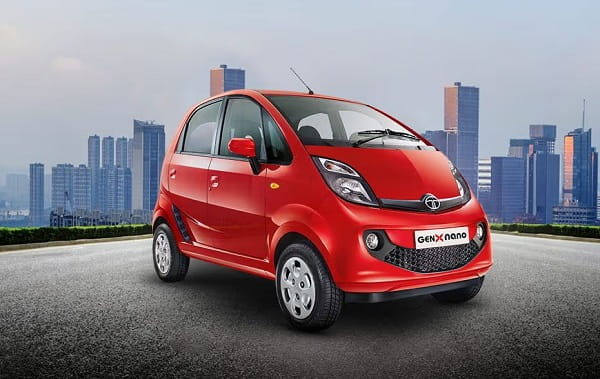
The Tata Nano GenX — launched in 2015 — represented a significant upgrade. It added an Easy Shift AMT automated manual transmission option, making the Nano one of the most affordable automatic cars in India. It brought a touchscreen infotainment system, improved cabin quality, a more contemporary exterior design, and updated safety features. The GenX was available in five variants — XE, XM, XT, XMA, and XTA — with the AMT suffix denoting automatic transmission. Last recorded ex-showroom prices for the GenX ranged from Rs. 2.47 lakh for the XE manual to Rs. 3.43 lakh for the XTA automatic.
A CNG variant — the Nano CNG — was developed for specific city markets, offering dramatically reduced running costs for fleet and commercial operators. The CNG Nano’s efficiency of 36 km/kg under ARAI certification made it extraordinary for its size and purpose.
Why the Nano Was Discontinued
The Nano’s discontinuation, which effectively occurred around 2018 to 2019 during the transition to BS6 emission norms, was the result of several converging forces rather than any single cause.
The first was the Rs. 1 lakh price tag itself — a brilliant marketing concept that became a commercial liability. In Indian consumer psychology, a car priced at Rs. 1 lakh was not aspirational. It was the car you bought because you could not afford anything better, and no self-respecting Indian family wanted that association. Potential buyers who could have genuinely benefited from the Nano declined to purchase it precisely because of what it symbolised. The “poor man’s car” label, despite being attached to a genuinely clever piece of engineering, proved commercially fatal.
The second was safety perception. Global NCAP tested the Nano and found its crash protection inadequate by modern standards. At a time when Indian consumers were becoming increasingly safety-conscious, a car associated with inadequate crash performance faced significant headwinds regardless of its price advantages.
The third was competition. The used-car market democratised affordable four-wheeled mobility remarkably effectively. A second-hand Maruti Alto 800 in Rs. 1.5 to 2 lakh range offered a more socially acceptable, mechanically proven, and service-network-backed alternative to a new Nano. The secondhand market essentially filled the market gap the Nano was trying to address.
The fourth was the BS6 upgrade investment calculus. Updating the Nano’s tiny 624 cc two-cylinder engine to meet BS6 emission standards would have required capital investment that Tata Motors could not justify against the vehicle’s declining sales volume. Monthly sales had fallen to single digits by 2018. Discontinuation was inevitable.
What Made the Nano Special: Specifications and Engineering
Despite its commercial story, the Nano’s engineering deserves respect on its own terms. The 624 cc two-cylinder naturally aspirated petrol engine placed in the rear of the car produced 38 PS at 5,500 rpm and 51 Nm of torque at 4,000 rpm. Maximum speed was approximately 105 kmph. The rear-engine layout — sharing conceptual architecture with the original Volkswagen Beetle and the classic Fiat 500 — freed up floor space in the cabin, giving the Nano an interior spaciousness disproportionate to its external dimensions of 3,099 mm length, 1,495 mm width, and 1,652 mm height.
Ground clearance of 180 mm was well-suited to Indian city roads, and the small turning radius of approximately 4 metres made it genuinely easier to park and manoeuvre in Mumbai’s and Delhi’s densest traffic than virtually any other car available. Kerb weight was approximately 600 to 680 kg depending on variant — the lightest production car sold in India — which contributed directly to its frugal fuel consumption. The 15-litre fuel tank was compact but adequate for a city car with such strong efficiency.
Features Across Variants
By the GenX generation, the Nano’s feature set had evolved meaningfully from its spartan origins. The base XE remained extremely basic — manual windows, no air conditioning, no power steering, and a simple audio system. The XM added power steering — a critical addition for city driving comfort. The XT brought air conditioning, which transformed the car’s usability in India’s climate. The XTA and XMA automatic variants added the innovative Easy Shift AMT system that allowed clutchless driving without a traditional automatic transmission’s cost and mechanical complexity.
The Nano GenX additionally offered a 7-inch touchscreen infotainment system with Bluetooth connectivity and rear camera support on higher variants — genuinely impressive for a sub-Rs. 3.5 lakh car. A revised front fascia with redesigned headlamps, updated bumpers, and improved paint quality gave the GenX a more contemporary appearance than the original’s purely functional look. Available colours across the range included Sunshine Yellow, Coral Orange, Ivory White, Mellow Red, Midnight Black, and Spearmint Green — a cheerful palette that deliberately positioned the Nano as a youthful, urban choice.
Safety features included a crumple zone at the front, a reinforced roof structure, seat belts, and the structural integrity of a welded monocoque shell — genuine if modest protective architecture. Higher GenX variants also included fog lamps, body-coloured bumpers, and improved NVH insulation that meaningfully reduced the original car’s notorious cabin noise.
Mileage: The Nano’s Genuine Strength
This is where the Nano delivered unambiguous and consistent merit. ARAI-certified mileage for petrol variants ranged from 25.35 to 36 kmpl across different configurations — exceptional for a car of any price. The GenX petrol manual variants typically achieved 21.9 to 23.6 kmpl under ARAI testing. Real-world owner reports in city driving conditions — exactly the environment the Nano was designed for — consistently delivered 18 to 22 kmpl with air conditioning active. Highway driving at steady speeds produced figures approaching 24 to 26 kmpl. The CNG variant’s 36 km/kg ARAI rating, combined with CNG’s significantly lower price per unit of energy compared to petrol, made the Nano CNG extraordinarily economical to operate for high-mileage city users such as taxi operators and commercial fleet managers.
Annual maintenance costs of approximately Rs. 750 to Rs. 1,200 — among the lowest of any car sold in India — made the Nano’s total cost of ownership the most competitive in its segment by a considerable margin. Spare parts remain available through authorised Tata service centres and the broader aftermarket, making running costs for existing Nano owners in 2026 still remarkably low.
Used Nano Market in 2026
In the absence of new production, the Tata Nano exists in 2026 exclusively in the used car market. Well-maintained examples — particularly GenX variants with AMT, air conditioning, and modest mileage — change hands at prices starting from as low as Rs. 35,000 for older, higher-mileage units and reaching Rs. 1.10 lakh or slightly above for clean GenX condition examples. The average used Nano price currently hovers around Rs. 1.10 lakh, reflecting both the car’s modest original cost and the genuine utility it continues to provide as a first car, city runabout, or second household vehicle for short-distance use.
Will the Nano Return? The 2026 Perspective
The possibility of a Nano revival generates regular headlines in India’s automotive media, and the interest is not without basis. Ratan Tata himself, in interviews before his passing, expressed a desire to see a new Nano — one that addressed the original’s shortcomings in safety, features, and perception while retaining its fundamental accessibility mission. Several industry analyses suggest that a next-generation Nano built on Tata’s modern platform architecture with BS6-compliant engines, better crash protection, contemporary features, and a price point in the Rs. 3 to 4 lakh range ex-showroom could find a genuine market gap between two-wheelers and the current cheapest new cars.
A Nano EV concept — an electric city car in the Rs. 5 to 7 lakh bracket — has also been discussed as a potential evolution, leveraging Tata’s significant EV expertise developed through the Nexon EV, Tiago EV, and Punch EV. The structural simplicity of an electric drivetrain in a small city car could theoretically make the economics work in a way that petrol engineering did not. Whether Tata Motors translates this potential into a real product remains officially unconfirmed as of mid-2026, but the conversation’s persistence reflects a genuine market reality: there are still millions of Indian families on two-wheelers who cannot afford the cheapest new car currently on sale, and the gap the Nano was meant to fill has never truly been closed by anyone else.
FAQs
Q: Is the Tata Nano still available to buy new in India in 2026?
A: No — the Tata Nano was officially discontinued around 2018 to 2019 during the transition to BS6 emission standards. It is available only in the used car market, with prices starting from approximately Rs. 35,000 for older units and reaching Rs. 1 to 1.2 lakh for well-maintained GenX condition examples.
Q: What was the last official price of the Tata Nano when it was discontinued?
A: The Nano’s last recorded ex-showroom prices ranged from approximately Rs. 2.05 to 2.97 lakh for the standard Nano and Rs. 2.47 to 3.43 lakh for the Nano GenX, depending on variant and transmission type.
Q: What was the Tata Nano’s mileage?
A: ARAI-certified mileage ranged from 21.9 to 25.35 kmpl for petrol manual variants, with the GenX AMT returning approximately 23.6 kmpl. The CNG variant achieved an exceptional 36 km/kg — making it one of the most fuel-efficient cars ever sold in India.
Q: Why was the Tata Nano discontinued?
A: The primary reasons were its inability to meet updated safety and crash protection standards under new NCAP requirements, the commercial challenge of the Rs. 1 lakh price tag creating a negative “poor man’s car” perception, declining sales volumes, and the financial impracticality of upgrading its 624 cc engine to meet BS6 emission norms.
Q: Is there a new Tata Nano coming in 2026 or 2027?
A: No official announcement or confirmation has been made by Tata Motors as of mid-2026. However, industry speculation about a next-generation Nano — either a petrol variant in the Rs. 3 to 4 lakh range or a Nano EV in the Rs. 5 to 7 lakh bracket — continues actively, reflecting genuine market demand for ultra-affordable four-wheeled mobility in India.