Maharashtra is India’s most economically dynamic state and one of its most culinarily diverse — a land whose food traditions span the refined coastal Konkan cuisine of the Saraswat Brahmin communities, the fiery Kolhapuri cooking of the southern districts that produces some of India’s most aggressively spiced preparations, the distinctive Vidarbha regional cooking of the eastern plateau, the theatrical street food culture of Mumbai that has influenced Indian urban food everywhere, and the festival-linked sweet traditions that give Maharashtrian celebrations their distinctive culinary identity. No single food descriptor adequately captures Maharashtra’s cooking — it is simultaneously coconut-rich and peanut-dependent, fiercely spicy and delicately sweet, street-food democratic and temple-cooking refined.
Maharashtra’s food philosophy differs meaningfully from many Indian regional cuisines in its emphasis on peanuts, sesame, and dried coconut as primary flavour builders rather than the cream, ghee, and nut pastes that dominate North Indian cooking. This distinctiveness creates a cuisine of genuine originality — preparations that taste like nothing else in Indian cooking, built on ingredient combinations and techniques that reflect Maharashtra’s specific agricultural landscape and cultural heritage.
| Dish | Origin Region | Primary Flavour | Best Time to Eat | Price Range |
| Vada Pav | Mumbai | Spicy, savoury, garlicky | Breakfast / Snack | ₹15–₹50 |
| Misal Pav | Pune / Nasik / Kolhapur | Fiery, tangy, complex | Breakfast / Brunch | ₹60–₹200 |
| Puran Poli | Pan-Maharashtra | Sweet, aromatic, jaggery-rich | Festival / Lunch | ₹30–₹100 |
| Kolhapuri Chicken / Mutton | Kolhapur | Intensely spicy, coconut-based | Lunch / Dinner | ₹200–₹600 |
| Modak | Konkan / Pan-Maharashtra | Sweet, steamed, coconut-jaggery | Festival / Dessert | ₹20–₹80 |
1. Vada Pav — Mumbai’s Most Democratic Masterpiece
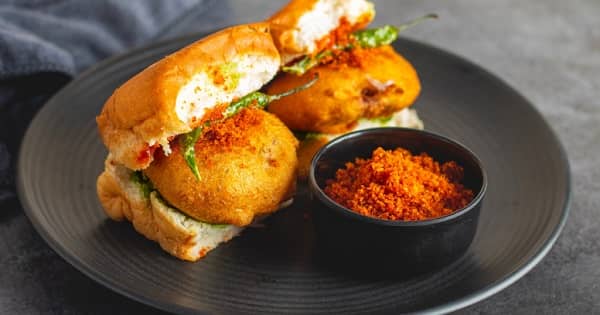
Vada Pav is Mumbai’s greatest culinary contribution to India — a humble, inexpensive, extraordinarily satisfying street food preparation that feeds millions of Mumbaikars daily and has achieved a cultural significance in the city that extends far beyond its modest ingredients. Called Mumbai’s burger by food writers attempting to communicate its format to international audiences, the comparison is technically accurate but spiritually inadequate — Vada Pav is not Mumbai’s version of a hamburger but something entirely original, born from the specific intersection of Maharashtrian food tradition, Mumbai’s working-class demographics, and the city’s restless energy that demands maximum satisfaction at minimum cost and time.
The components are deceptively simple — a spiced potato vada enclosed in seasoned chickpea batter and deep fried to golden crispness, placed inside a soft white pav bread that has been generously smeared with multiple chutneys. The execution, however, requires a precision and a specific combination of elements that makes a great Vada Pav something entirely different from a mediocre one. The vada itself must be made from potatoes boiled and mashed with a tempering of mustard seeds, curry leaves, turmeric, and green chilli — the potato mixture just firm enough to hold shape through frying without becoming dense. The batter must be thin enough to form a delicate shell rather than a thick coating.
The chutney combination is Vada Pav’s soul — the dry garlic chutney of roasted garlic pounded with dried coconut and Kashmiri chilli powder that provides the most distinctive flavour note, combined with a fresh green coriander-chilli chutney for brightness and a tamarind-date chutney for sweet acidity. These three chutney layers applied to the warm pav create a flavour architecture of remarkable complexity for what costs between ₹15 and ₹30 at most Mumbai street vendors.
The history of Vada Pav traces to 1966 when Ashok Vaidya set up the first dedicated Vada Pav stall outside Dadar station — recognising that the thousands of mill workers and station commuters needed something fast, filling, and affordable. The format succeeded with extraordinary completeness — today Mumbai has an estimated 30,000 Vada Pav vendors serving several million portions daily, making it arguably India’s most consumed single street food item. Eating Vada Pav at a good Mumbai street vendor — standing on the pavement, eating quickly, watching the city move around you — is one of Indian street food culture’s defining experiences.
2. Misal Pav — Maharashtra’s Most Complex Breakfast
Misal Pav is Maharashtra’s most intellectually interesting street food — a preparation of layered complexity and regional variation that has passionate advocates across different Maharashtra cities each arguing that their local version represents the authentic original. Pune Misal, Nasik Misal, Kolhapur Misal, and Mumbai Misal each have distinct characteristics — different spice levels, different garnishing philosophies, different gravy bases — creating a single dish name that actually encompasses a family of related preparations with shared DNA but individual personalities.
At its core, Misal involves sprouted moth beans or mixed sprouts cooked in a spiced gravy called usal — this cooked sprout preparation is then ladled into a bowl, topped with a fiery red tarri or kat (thin, intensely spiced oil-based gravy), covered with a generous topping of farsan (mixed dry snack mixture of sev, chiwda, poha, and fried items), finished with raw onion, fresh coriander, a squeeze of lemon, and served with pav bread on the side. The textural contrast between the yielding cooked sprouts, the sharp farsan crunch, the crisp raw onion, and the soft bread creates the multi-dimensional eating experience that makes Misal Pav Maharashtra’s most complex and most satisfying breakfast.
The tarri — the thin, brilliantly red, intensely spiced gravy poured over the base usal — is where regional identity is most fiercely expressed. Kolhapur’s tarri is among India’s most aggressively spiced preparations — using the famous black masala that combines dried coconut with specific Kolhapuri chilli varieties to create a heat and depth that is genuinely challenging and genuinely extraordinary simultaneously. Pune’s version tends toward balanced spicing where the sprout’s natural flavour is more prominent. Nasik Misal has its own balance point between these poles.
Misal Pav restaurants across Maharashtra’s cities — particularly the legendary establishments of Pune’s Budhwar Peth and Mandai area, or Nasik’s city centre Misal destinations — have developed loyal followings whose commitment to their preferred Misal vendor approaches the devotional. Queues at the best Misal establishments form before opening time and the morning crowds treat breakfast as a genuinely important daily ritual rather than a perfunctory nutritional obligation.
3. Puran Poli — Maharashtra’s Festival Soul
Puran Poli occupies a position in Maharashtrian food culture that transcends mere cuisine — it is the taste of celebration itself, prepared for Holi, Gudhi Padwa, Diwali, family religious ceremonies, and the welcoming of important guests with a significance that makes it impossible to separate from the festivals and occasions it marks. Every Maharashtrian household has its specific Puran Poli recipe — the precise ratio of chana dal to jaggery in the filling, the specific spice additions of cardamom and nutmeg, the exact consistency of the outer wheat dough — and these specific recipes carry forward through family generations as expressions of culinary identity and emotional continuity.
The preparation involves two components of equal importance — the puran (filling) and the poli (outer flatbread). The puran is made by pressure cooking chana dal to complete softness, then cooking it down with jaggery in a heavy pan over patient medium heat, stirring constantly until the mixture reaches a consistency firm enough to hold shape when rolled into a ball. Cardamom powder adds floral fragrance, nutmeg provides warmth, and some family recipes add a pinch of dry ginger or pepper that creates a gentle background heat. The filling should be perfectly smooth — a sign that it has been cooked long enough and worked sufficiently.
The poli is made from a soft, well-rested dough of wheat flour with a small proportion of refined flour — the elasticity of the dough being critical to stretching thin enough to completely encase the filling without tearing. The filled dough ball is rolled out into a thin flatbread and cooked on a hot iron tawa with generous ghee applications — the finished Puran Poli should be golden, slightly crisp at the edges, and give the filled sweet against the wheat outer layer with each bite.
Puran Poli served with a pool of pure desi ghee and warm aamras (mango pulp) during summer festivals — particularly Gudhi Padwa when both are traditionally served together — creates one of Maharashtra’s most deeply satisfying and most culturally resonant meal combinations.
4. Kolhapuri Cuisine — Maharashtra’s Most Fiery Tradition
Kolhapuri cooking represents the boldest and most uncompromising expression of Maharashtra’s southern regional culinary identity — a cooking tradition from the Kolhapur district that has given India some of its most intensely flavoured, most aggressively spiced meat preparations and established a regional food identity so strong that Kolhapuri as an adjective has become shorthand for maximum spice intensity across the entire Indian restaurant industry.
The foundation of Kolhapuri cooking’s unique character is the Kolhapuri masala — a complex spice blend that uses dried coconut roasted to deep brownness alongside specific local chilli varieties, sesame seeds, coriander, and a combination of dry spices that creates a preparation with simultaneous heat, depth, nuttiness, and aromatic complexity. This masala is ground fresh for important preparations — the flavour difference between freshly ground Kolhapuri masala and stored pre-ground versions is immediately perceptible to anyone who has experienced both.
Kolhapuri Chicken and Kolhapuri Mutton are the preparations that have achieved national fame — bone-in pieces of meat cooked in this masala with a gravy of medium thickness that has the characteristic deep reddish-brown colour of well-roasted coconut and chilli. The preparation does not mask the meat’s natural flavour under cream or nut pastes as North Indian preparations might — instead, the masala intensifies and complements the meat character, creating a preparation where the protein and spice work together rather than one dominating the other.
Tambda Rassa and Pandhra Rassa — the red meat soup and white meat soup served as the introductory courses of a traditional Kolhapuri non-vegetarian meal — represent the purest expression of Kolhapuri cooking philosophy. The red rassa is intensely spiced and deeply coloured. The white rassa is made from coconut milk with a completely different, mild, coconut-forward flavour profile. Together they establish the range of Kolhapuri cooking — from maximum intensity to unexpected delicacy — before the main preparations arrive.
5. Modak — Ganesha’s Sacred Sweet
Modak is Maharashtra’s most spiritually significant food preparation — the sweet offering most closely associated with Lord Ganesha, prepared in enormous quantities during Ganesh Chaturthi when Maharashtra’s most beloved festival celebration brings communities together for ten days of worship, procession, and the communal preparation of the divine elephant god’s favourite food. No other Indian regional sweet is as specifically and as deeply connected to a single deity and a single festival — Modak is not merely festival food but sacred food, prepared as an offering before being consumed as prasad that carries the blessing of the deity’s acceptance.
The traditional steamed Modak — ukadiche Modak — is a preparation of genuine technical skill. The outer shell is made from rice flour cooked with boiling water to a smooth, pliable dough that must be worked immediately before it cools and loses its workability. The filling combines freshly grated coconut with jaggery, cooked together with cardamom and nutmeg until the jaggery melts and integrates with the coconut, creating a filling of concentrated sweetness and tropical fragrance. The dumpling is formed by moulding small portions of rice dough into thin cups, filling with the coconut-jaggery mixture, and pleating the edges into the characteristic pointed topknot that gives Modak its distinctive silhouette. The shaped dumplings are steamed until the rice outer shell becomes translucent and tender.
The steamed Modak has a clean, pure quality — the natural sweetness of jaggery and coconut coming through without heavy frying or excessive sugar, the rice shell providing neutral starch that allows the filling’s flavour to dominate. A small amount of pure ghee drizzled over warm steamed Modak at serving completes the experience with a dairy richness that harmonises everything perfectly.
Fried Modak — talniche Modak — is a festival variant where the same filling is enclosed in a wheat dough and deep fried to golden crispness, creating the contrast between crunchy exterior and soft, sweet filling that makes it irresistible to children and adults who find the steamed version’s delicacy insufficiently indulgent. Both variants are prepared in every Maharashtrian household during Ganesh Chaturthi — the steamed version as the primary sacred offering and the fried version for the celebratory household consumption that the ten-day festival sustains.
Maharashtra’s Food Identity
Maharashtra’s culinary greatness lies in its extraordinary range — from the ethereal delicacy of steamed Modak to the savage intensity of Kolhapuri mutton, from the democratic accessibility of Vada Pav to the festival reverence of Puran Poli. No other Indian state’s food culture spans so broad a spectrum while maintaining such fierce regional identity at every point. The common threads that unite this diverse culinary landscape are peanuts and sesame as primary enrichers, coconut in both fresh and dried forms as a flavour builder, tamarind and kokum providing characteristic sourness, and the confident application of heat that makes Maharashtra’s cooking instantly recognisable regardless of regional variation.
Frequently Asked Questions (FAQs)
Q: Which is the most popular food of Maharashtra?
A: Vada Pav is Maharashtra’s most widely consumed and most universally recognised food — Mumbai’s iconic street food eaten daily by millions across the state and increasingly across urban India.
Q: Is Maharashtrian food very spicy?
A: It varies significantly by region — Kolhapuri food is among India’s spiciest. Mumbai street food is moderately spiced. Konkan coastal cooking is milder with coconut-forward flavours. Brahmin Maharashtrian cooking uses minimal heat.
Q: Where is Misal Pav most famous?
A: Pune, Nasik, and Kolhapur each claim the best Misal — all three cities have dedicated establishments with generations of loyal customers. Each city’s version has distinctive characteristics worth experiencing separately.
Q: Can Modak be made at home?
A: Yes — though ukadiche Modak requires practice to master the pleating technique. Fried Modak is more forgiving for beginners. Most Maharashtrian families consider home-made Modak essential for Ganesh Chaturthi regardless of skill level.
Q: What makes Kolhapuri food different from other spicy Indian cuisines?
A: Kolhapuri cooking’s unique character comes from its roasted dried coconut and specific local chilli masala base — creating heat alongside nuttiness and depth that differs from the heat of North Indian preparations or South Indian spicing.